Jawaharlal Nehru University (JNU) was inaugurated on 14 November 1969 by Shri V. V. Giri, the then President of India. JNU campus is spread over 1000 acres of undulated terrain. JNU is the foremost university in India, and a world-renowned centre for teaching and research. JNU being an institute of eminence in India aspires to create an augmented and integrated ecosystem, with a unique combination of resources, innovative thinking, and careful planning catapulting it to the creation of a University that would be recognized in the league of world-class institutions. JNU’s overarching strategy is to create mechanisms that include the cycle of strategic planning and execution, concrete time-bound implementation, real-time project progress monitoring and robust review system as vehicle to propel the Jawaharlal Nehru University in leagues of other self-sufficient and self-sustained world-class teaching and research system. The University was envisioned as an institution essentially for post-graduate teaching and research. Currently, the University has thirteen Schools. It also has nine Special Centres
Established in 1969, and thus one of the founding blocks of the Jawaharlal Nehru University, the School of Language, Literature and Culture Studies (SLL&CS) is one of the premier institutions in India in the field of learning languages and pursuing higher studies and research in linguistics, literatures in various languages, and culture studies. Its global reputation has earned it place as one of the five degree-awarding partners of the prestigious Erasmus Mundus Joint Doctorate in “Cultural Studies in Literary Interzones” of the European Union, and one of its constituents, the Centre for English Studies, has been repeatedly adjudged as one of the top 100 departments of literary studies in the world. Furthermore, all the Centres of the School, and the School itself, have active international collaborations with leading universities of the world.
SLL&CS has twelve centres: Centre of Arabic and African Studies (CAAS), Centre for Chinese and South-East Asian Studies (CCSEAS), Centre for English Studies (CES), Centre for French and Francophone Studies (CFFS), Centre of German Studies (CGS), Centre of Indian Languages (CIL), Centre for Japanese Studies (CJS), Centre for Korean Studies (CKS), Centre for Linguistics (CL), Centre of Persian and Central Asian Studies (CPCAS), Centre of Russian Studies (CRS), and Centre of Spanish, Portuguese, Italian and Latin American Studies (CSPILAS). Besides, the School also has a well-equipped Language Labs and Multimedia Complex (LLC).
JNU is the first University in India to create a Centre of French and Francophone Studies. The new nomenclature of the Centre has vital academic, national and international implications. The teaching and research carried out in the French Language on the Francophone(French speaking) countries would benefit the scholars of the Centre, should facilitate interdisciplinary and multidisciplinary research between the Centre and other Centres of the Schools at JNU as well as with other universities and institutions both in India and abroad. In this way, the Francophone Centre would eventually become a rich resource and documentation centre accessible to institutions and individuals.
Thirteen distinguished faculty work in CFFS with nearly three hundred students pursuing bachelors, masters and PhD programs.
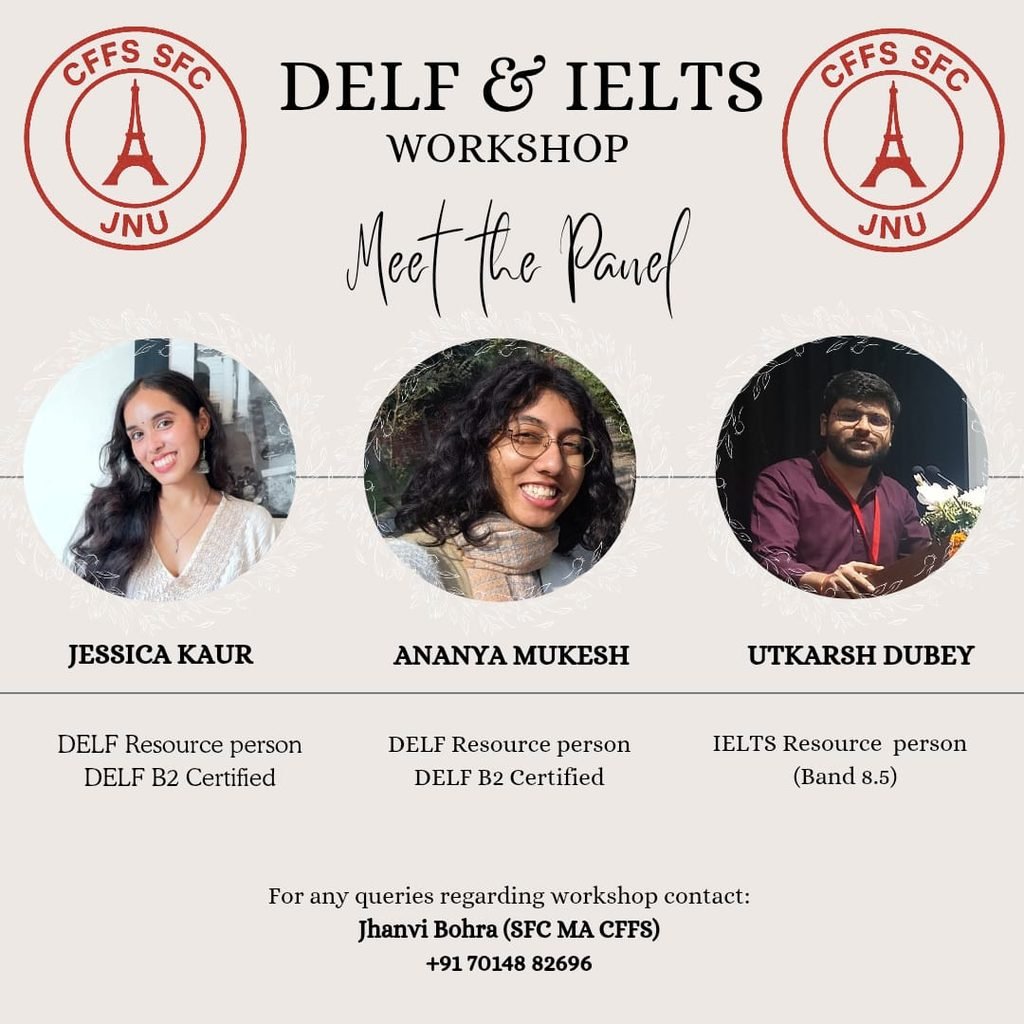
Students in CFFS pursuing Bachelors and Masters aspire to study/work abroad especially in France and Francophonie countries apart from English speaking countries. Towards meeting the eligibility of certification in French and English languages, workshops like DELF&IELTS are organised within the Centre.
I was chosen as a panelist donning the role of DELF B2 Resource Person. During the course of interaction with aspiring students, I shared important insights for achieving Upper Level Intermediate Certification (DELF B2) in French for non-native French Speakers. I made them familiar with structure/duration of the exam and then distribution of marks in each sections.
For the workshop participants to experience the exam, I conducted mock speaking sessions (one on one) and how to avoid common mistakes to boost their scores. I laid emphasis on Production Ecrite being the tough part in scoring maximum marks. I provided them confidence that students of our Centre are better placed due to their exposure to writing French constantly and assessed by distinguished faculty. I emphasised to the workshop participants that DELF B2 tests the endurance of candidates as the exam is spread over one full day testing all four skills i.e. listening, reading, writing and speaking.
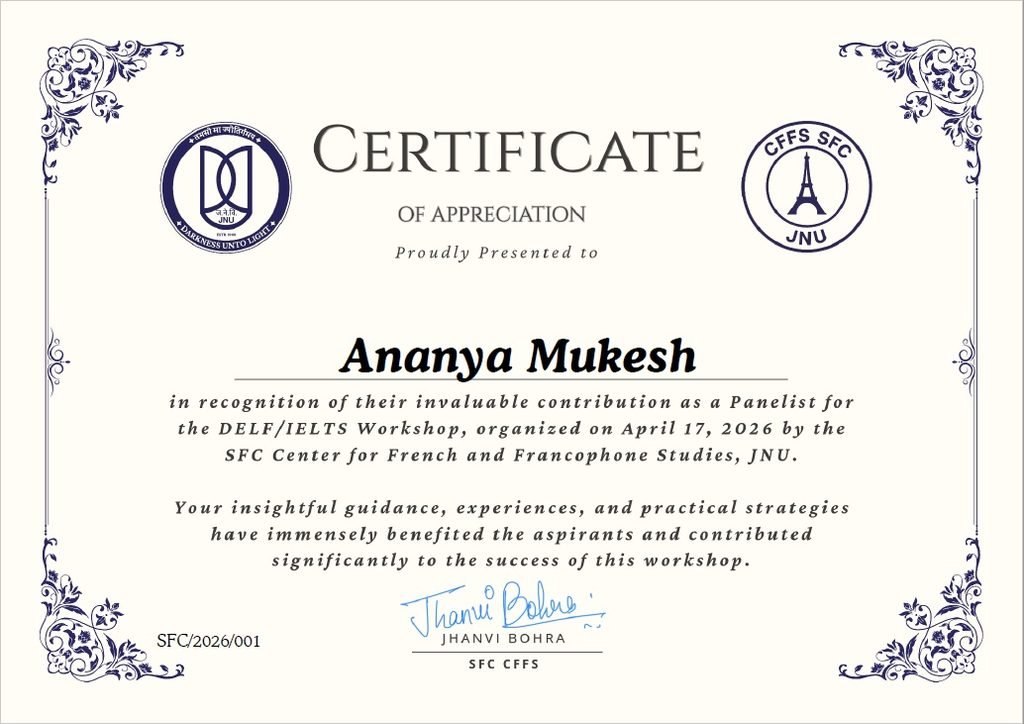
I was awarded a Certificate of Appreciation for my insightful guidance and practical strategies.